|
||
 |
||
 |
||
|


(C)2001 Japanese Architecture and Art Net Users System. No reproduction or republication without written permission.
掲載のテキスト・写真・イラストなど、全てのコンテンツの無断複製・転載を禁じます。
|
||||||
| fumi-ishi 踏石 | ||||||
|
||||||
|
||||||
|
||||||
|
||||||
| KEY WORD : architecture / tea houses | ||||||
|
||||||
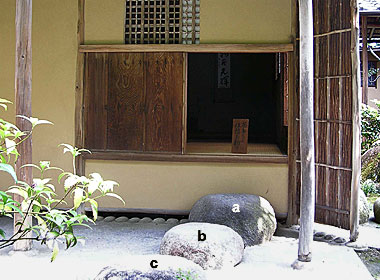
| Lit. stepping stone. The stone placed directly under the crawl door entrance *nijiriguchi 躙口, of a tea ceremony hut *chashitsu 茶室. One of the trump stones *yaku-ishi 役石, because of its placement closest to the chashitsu, it is also called the first stone *hatsu-no-ishi 初の石. It is considered best to arrange the fumi-ishi so that the guest kneeling on it will be close to the floor of the nijiriguchi, to facilitate easy entrance. Therefore, a somewhat large stone with a flat top is used, and it is placed about 18cm away from the chashitsu so that the top is about 36cm below the entrance sill. The height of the fumi-ishi depends on the height if the nijiriguchi. Next to the fumi-ishi are the falling stone *ochi-ishi 落石, and the mounting stone *nori-ishi 乗石. Occasionally, the term fumi-ishi refers to two of the trump stones located in the ornamental toilet, *sunasetchin 砂雪隠. According to *CHADOU SENTEI 茶道筌蹄 (1816), the stone at the entrance to the sunasetchin is called the under-the-door stone, toshita-no-ishi 戸下の石, while the stones to either side are called fumi-ishi. They are divided into the front stone *mae-ishi 前石, and the foot rest stone, ashikake-ishi 足掛石. | ||||||
|
||||||
|
||||||
|
||||||
| REFERENCES: | ||||||
| *koshikake machiai 腰掛待合, *dan 段 | ||||||
|
||||||
|
||||||
|
||||||
| EXTERNAL LINKS: | ||||||
|
||||||
|
||||||
|
||||||
| NOTES: | ||||||
|
||||||
|
||||||
|
||||||
(C)2001 Japanese Architecture and Art Net Users System. No reproduction or republication without written permission. 掲載のテキスト・写真・イラストなど、全てのコンテンツの無断複製・転載を禁じます。 |
||||||