|
||
 |
||
 |
||
|


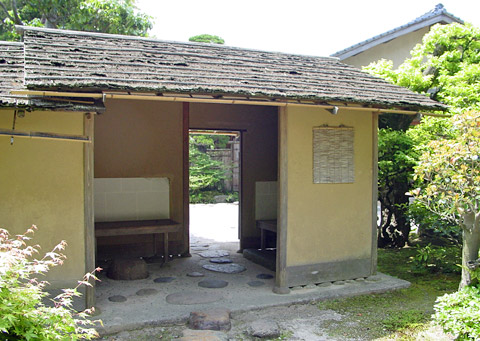
Meimei'an
明々庵 (Shimane)
(C)2001 Japanese Architecture and Art Net Users System. No reproduction or republication without written permission.
掲載のテキスト・写真・イラストなど、全てのコンテンツの無断複製・転載を禁じます。
|
||||||
| koshikake machiai 腰掛待合 | ||||||
|
||||||
|
||||||
|
||||||
|
||||||
| KEY WORD : architecture / tea houses | ||||||
|
||||||
| A place provided in a tea garden where the mood and expectations of the participants are intensified while they wait until called to enter the tea ceremony room. While waiting the host may appear to welcome the guests. Some participants also wait until there for a second time until there is a signal for entering the tea ceremony room after a rest period or after a tea ceremony meeting. If the tea ceremony is to be held in the outer garden, the waiting area is called the outer waiting shelter, sotokoshikake 外腰掛. If it is to be performed in the inner garden, the waiting place is called the inner waiting shelter, uchikoshikake 内腰掛. Some waiting places are in a pyramidal style called doukoshikake 堂腰掛. However, usually it is in the manekiyane 招き屋根 style in which one side of the roof has normal length, but the other side is short. The front is open and a bench is provided for the guests. The bench usually has long boards, kure-ita 槫板, often covered with straw mats. Bamboo blinds may be hung to indicate the placement of honored guests followed by their companions, and then those of lower rank. A stepping stone *fumi-ishi 踏石, used by guests is sometimes large, in which case it is called *kinin-ishi 貴人石. It is used like a trump stone *yaku-shi 役石. | ||||||
Meimei'an
明々庵 (Shimane)
|
||||||
|
||||||
|
||||||
| REFERENCES: | ||||||
|
||||||
|
||||||
|
||||||
| EXTERNAL LINKS: | ||||||
|
||||||
|
||||||
|
||||||
| NOTES: | ||||||
|
||||||
|
||||||
|
||||||
(C)2001 Japanese Architecture and Art Net Users System. No reproduction or republication without written permission. 掲載のテキスト・写真・イラストなど、全てのコンテンツの無断複製・転載を禁じます。 |
||||||