|
|
| |
| gatou 瓦当 |
 |
|
|
|
| KEY WORD : architecture
/ roofing tiles |
|
| |
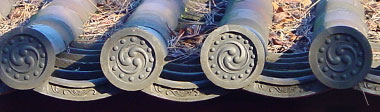
1 Eave-end
tiles with a circular or semi-circular ornamental pendant. Gatou
were brought to Japan from China and the Korean peninsular. Han dynasty
gatou were often decorated with auspicious characters. Japanese examples
are decorated with the comma shape *tomoemon 巴文, arabesque *karakusamon
唐草文, or other designs. Round gatou are called *engatou
円瓦当, and semi-circular gatou are called hangatou 半瓦当. Sometimes
pendant tiles are called by the name of the pattern decorating them. For
example, round gatou decorated with a comma pattern *tomoegawara 巴瓦,
are often referred to as eaves commas *nokidomoegawara
軒巴瓦. The pendant tiles not only apply a decorative finish to the edge of
the eaves but also serve to deflect the rain as they have a slightly outward
slant.
2 The term gatou is sometimes used to refer only to the decorative
pendant disk of the tiles described in one above.
|
| |
 |
|
|
|
| REFERENCES: |
| ,
*marugawara 丸瓦,
*rengemon 蓮華文, *gatou
mon'you 瓦当模様 |
|
|
|
| EXTERNAL LINKS: |
| |
|
|
|
| NOTES: |
|
|
|
|
|
(C)2001 Japanese Architecture and Art Net Users System. No reproduction
or republication without written permission.
掲載のテキスト・写真・イラストなど、全てのコンテンツの無断複製・転載を禁じます。 |
| |


