|
||
 |
||
 |
||
|


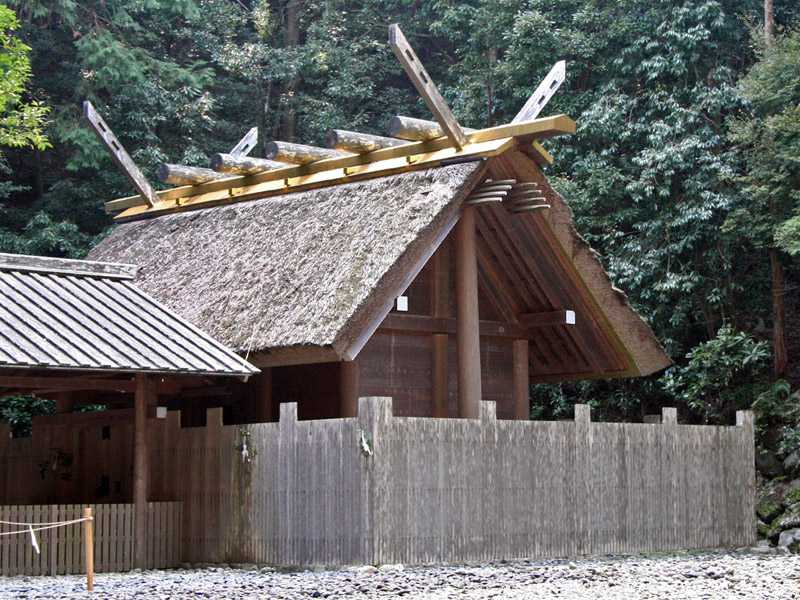
Ise Jinguu Gekuu Betsuguu Tsuchinomiya
伊勢神宮外宮別宮土宮 (Mie)
伊勢神宮外宮別宮土宮 (Mie)
(C)2001 Japanese Architecture and Art Net Users System. No reproduction or republication without written permission.
掲載のテキスト・写真・イラストなど、全てのコンテンツの無断複製・転載を禁じます。
|
||||||
| shinmei-zukuri 神明造 | ||||||
|
||||||
|
||||||
|
||||||
|
||||||
| KEY WORD : architecture / shrines | ||||||
|
||||||
| 1. An ancient style of Shinto shrine architecture used especially for the main sanctuary *honden 本殿. It is either a small, rectangular, 3 X 2 bay building made of stripped, untreated wood with one entrance on the long side *hirairi 平入, or if a one bay square structure, an entrance on the side at a right angle to the gable ends. It is raised several steps above ground level and is surrounded by a railed veranda. The roof is a simple gable type *kirizuma yane 切妻屋根, covered with thatch, board, board and batten, and now usually overlaid with copper sheeting, cypress bark or Japanese cedar shingles. The slope of the roof may be 45゜or less. Traditionally, pillars were sunk directly into the ground *hottatebashira 掘立柱: where base stones are used, they are buried deeply underground so that the pillars appear to be of the ancient sunken type. The ridge pole *munagi 棟木, receives full support from free-standing pillars, called *munamochibashira 棟持柱 or futabashira 二柱 on the gable ends. The bargeboards *hafu 破風, extend beyond the ridge line to form forked finials *chigi 千木. In most cases today, the chigi are made of separate pieces, okichigi 置千木, and are often placed to appear as if they are extensions of the bargeboards. Eight slender members *muchikake 鞭掛, four on either side, extend just below the peak of the bargeboard. A long peaked timber *kou-ita 甲板 or irakaooi 甍覆, is laid on top of the roof to form a ridge-like plate to carry the billets *katsuogi 堅魚木. Ridge protecting timbers *aori-ita 障泥板, are inserted under this long timber and are secured by pegs *hinuki 飛貫, extending through the ridge-protecting boards into the struts that secure the ridge. The ridge and billets are supported by struts called *hizuka 樋束 which are placed between the ridgepole and the ridge-like plate. The shinmei style is most widely seen in Mie prefecture, as exemplified by Ise Jinguu 伊勢神宮, main sanctuaries, also called *shouden 正殿. Other good examples are found at Nishina Shinmeiguu Honden 仁科神明宮本殿 (1636) in Nagano prefecture and Atsuta Jinguu Shouden 熱田神宮正殿 in Aichi prefecture. | ||||||
Ise Jinguu Gekuu Betsuguu Tsuchinomiya
伊勢神宮外宮別宮土宮 (Mie) |
||||||
|
||||||
|
||||||
| REFERENCES: | ||||||
|
||||||
|
||||||
|
||||||
| EXTERNAL LINKS: | ||||||
|
||||||
|
||||||
|
||||||
| NOTES: | ||||||
|
||||||
|
||||||
|
||||||
(C)2001 Japanese Architecture and Art Net Users System. No reproduction or republication without written permission. 掲載のテキスト・写真・イラストなど、全てのコンテンツの無断複製・転載を禁じます。 |
||||||