|
||
 |
||
 |
||
|


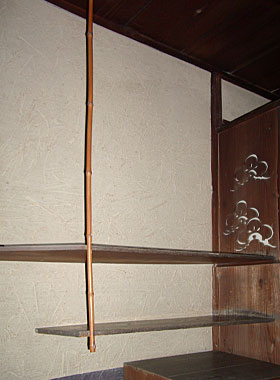
Nagatomi
永富 house (Hyougo)
(C)2001 Japanese Architecture and Art Net Users System. No reproduction or republication without written permission.
掲載のテキスト・写真・イラストなど、全てのコンテンツの無断複製・転載を禁じます。
|
||||||
| nijuudana 二重棚 | ||||||
|
||||||
|
||||||
|
||||||
|
||||||
| KEY WORD : architecture / tea houses | ||||||
|
||||||
| Also nijuu tsuridana 二重釣棚. A double hanging shelf *tsuridana 釣棚, characterized by one shelf being above the other. Used in tea rooms *chashitsu 茶室. The shelf boards may be of the same size or the upper one may be larger than the one below. In the latter case, the shelf is also called hibaridana 雲雀棚 according to the *CHASHIKI KOGETSUSHOU 茶式湖月抄 (1851). In general, the upper shelf is about 42cm x 31.5cm, the lower one about 30cm x 27cm, and both are about 1.2cm thick. The space between the two shelves is about 20cm. The lower shelf is either placed directly above the base board, hikigi 引木 or bamboo base *hikidake 引竹 of the sleeve wall *sodekabe 袖壁, or it is dropped a little below . When the shelves are the same size, they are hung from above by thin bamboo. But when the lower shelf is smaller, only the upper shelf is hung by bamboo and the lower one is suspended by a thin piece of wood attached to the underside of the upper shelf. Paulownia wood and green bamboo, the latter replaced annually, are generally used. The upper and lower shelves are attached when the first layer of mud plaster is laid on the wall and then the wall is covered with the finish coat. The CHASHIKI KOGETSUSHOU and the *NANBOUROKU 南坊録 both state that the double shelves were greatly favored by Furuta Oribe 古田織部 (1543-1615), and both state that they did not exist during Sen Rikyuu's 千利休 (1522-91) lifetime. The latter claims that the double shelves were originated by Oribe. A different opinion is presented, in the *SEKISHUU SANBYAKUKAJOU 石州三百箇条, written by Katagiri Sekishuu 片桐石州 (1605-73). Sekishuu states that even triple shelves of the same size were sometimes made. Furthermore, Sekishuu says that Rikyuu made double shelves differing from Oribe's shelves by having the top shelf the same as the bottom. The nijuudana at Omotesenke Fushin'an 表千家不審庵 are thought to be like the ones which Rikyuu made. The Fushin'an shelves have one slender bamboo piece attached slightly in from the corners. Examples of double shelves of differing sizes: Katsura Rikyuu, Shoukintei 桂離宮松琴亭; Daitokuji Kohouan, San'unjou-no-Seki 大徳寺孤篷庵,山雲床の席, both in Kyoto. | ||||||
|
Nagatomi
永富 house (Hyougo) |
||||||
|
||||||
|
||||||
| REFERENCES: | ||||||
| *ichijuudana 一重棚, *sanjuudana 三重棚 | ||||||
|
||||||
|
||||||
|
||||||
| EXTERNAL LINKS: | ||||||
|
||||||
|
||||||
|
||||||
| NOTES: | ||||||
|
||||||
|
||||||
|
||||||
(C)2001 Japanese Architecture and Art Net Users System. No reproduction or republication without written permission. 掲載のテキスト・写真・イラストなど、全てのコンテンツの無断複製・転載を禁じます。 |
||||||