|
|
| |
| shinmei
torii 神明鳥居 |
 |
|
|
|
| KEY WORD : architecture
/ shrines |
|
| |
| Also
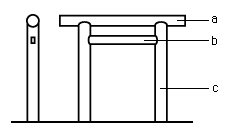
futabashira torii 二柱鳥居. A generic name for a Shinto gate *torii
鳥居, that has straight horizontal members. The simplest type of torii comprised
of four circular members: two pillars normally set perpendicular to the ground
but sometimes with slight inward incline *uchikorobi
内転, a top lintel *kasagi
笠木, and a tie beam *nuki 貫,
inserted into the pillars. Until fairly recently the pillars were embedded into
the ground *hottatebashira
堀立柱, to a depth of about 7 feet to insure stability. |
| |
| | | |
|
 | |
|
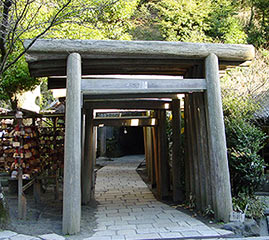
Zeniarai benten 銭洗弁天
(Kanagawa) |
|
|
|
|
| REFERENCES: |
| *shiromaruta
torii 白丸太鳥居, *ise
torii 伊勢鳥居, *kashima
torii 鹿島鳥居, *kasuga
torii 春日鳥居, *kuroki
torii 黒木鳥居, *hachiman
torii 八幡鳥居 |
|
|
|
| EXTERNAL LINKS: |
| |
|
|
|
| NOTES: |
|
|
|
|
|
(C)2001 Japanese Architecture and Art Net Users System. No reproduction
or republication without written permission.
掲載のテキスト・写真・イラストなど、全てのコンテンツの無断複製・転載を禁じます。 |
| |