|
||
 |
||
 |
||
|


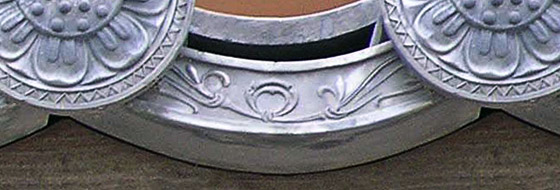
Houryuuji
Gojuu-no-tou 法隆寺五重塔 (Nara)
(C)2001 Japanese Architecture and Art Net Users System. No reproduction or republication without written permission.
掲載のテキスト・写真・イラストなど、全てのコンテンツの無断複製・転載を禁じます。
|
||||||
| nindou karakusamon 忍冬唐草文 | ||||||
|
||||||
|
||||||
|
||||||
|
||||||
| KEY WORD : architecture / roofing tiles | ||||||
|
||||||
| Also suikazura karakusamon; also nindou karakusa 忍冬唐草. Lit. honeysuckle arabesque pattern. A pattern used to decorate the pendants *gatou 瓦当 of broad, concave eave end tiles *nokihiragawara 軒平瓦. Existing examples have very fluid, delicate vine patterns which are rendered with a leaping vitality, as in those found at Houryuuji 法隆寺 and Hourinji 法輪寺 in Nara. This motif may be arranged symmetrically, to the right and left of a central design *chuushinkasari 中心飾. It may be deeply and heavily carved as exemplified by a fragment found at the Sakadadera 坂田寺 site in Nara. It may also have a continuous pattern without a central motif *henkou karakusamon 扁行唐草文. Some fragments from Houryuuji have a large heavy, fan-shaped motif senkei nindou karakusamon 扇形忍冬唐草文 with the same motif alternating between being rightside up, like a tree, and the next inverted. This motif is also called palmette or apricot leaf arabesque motif kyouyou karakusamon 杏葉唐草文. | ||||||
Houryuuji
Gojuu-no-tou 法隆寺五重塔 (Nara)
|
||||||
|
||||||
|
||||||
| REFERENCES: | ||||||
| *kinsei karakusamon 均正唐草文 | ||||||
|
||||||
|
||||||
|
||||||
| EXTERNAL LINKS: | ||||||
|
||||||
|
||||||
|
||||||
| NOTES: | ||||||
|
||||||
|
||||||
|
||||||
(C)2001 Japanese Architecture and Art Net Users System. No reproduction or republication without written permission. 掲載のテキスト・写真・イラストなど、全てのコンテンツの無断複製・転載を禁じます。 |
||||||