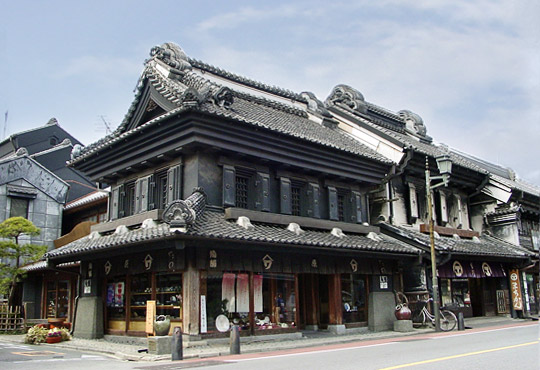
| A
shop constructed using the fireproof system of construction known as *dozou-zukuri
土蔵造 or *kura-zukuri 蔵造.
The misegura is believed to have developed in Edo, probably in the years
following the fire which destroyed the city in 1657. An early example, for which
some records survive, was the Daikokuya 大黒屋 (1662). However, it was not
until after the shogunate government began to encourage construction of storehouses
kura 蔵 in the Kyouho 享保 era (1716-35) that misegura became numerous.
From Edo, the style spread to other towns of the Kantou 関東 region. Kawagoe 川越, Saitama
prefecture, has one of the oldest surviving examples, the Oosawa 大沢 House (1792),
and also has a number of late 19c examples. Misegura not only dominated
the streetscape of towns throughout the Kantou in the late 19c, but spread north
as far as Hokkaidou, and even gained a foothold in the Kansai 関西 region (the earliest
misegura in Osaka is said to have been erected in around 1850). Misegura
were usually two story structures directly overlooking the street. Most had their
entrance on the non-gabled side of the building (see *hirairi
平入). The shop was on the ground floor, which had a tiled veranda *hisashi
廂 , and often a storage pit, anagura 穴蔵, beneath. The entire shopfront
could be closed with heavy fireproof plastered sliding shutters *tsuchido
土戸. Fireproof plastered double-hinged swing doors *kannonbiraki
tobira 観音開扉, opened the rear of the shop to the rest of the plot behind.
The misegura could thus be sealed from front and rear in case of fire.
The upper floor was used for storage, as accommodation for employees, or as a
reception room *zashiki
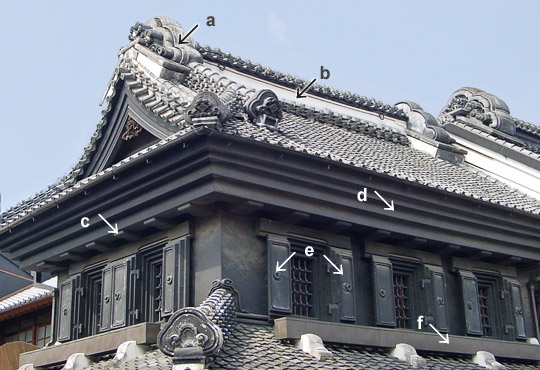
座敷, for entertaining guests or customers. The upper floor facade had either plastered
latticework *koushi
格子, with fireproof sliding shutters or small windows closed with kannonbiraki
tobira, usually placed symmetrically. For the eaves, a round eaves purlin
* dashigeta 出桁, and an
inverted stepped profile, nokijabara 軒蛇腹, were preferred to the thick plaster
under the eaves *hachimaki
鉢巻, found in the conventional mud-wall storehouses. A white plaster finish was
common in the 18c but in Kantou black plaster became the dominant fashion by the
latter half of the 19c. The roof was usually gabled *kirizuma yane
切妻屋根 and tiled with pan tiles *sangawara
桟瓦. The built-up box ridge *hakomune
箱棟, with large goblin-mask tiles *onigawara
鬼瓦 and oversized scroll-like plaster decoration *kagemori
影盛, were very prominent features, especially in later examples. Misegura
were an expensive symbol of a merchant's wealth. |