|
||
 |
||
 |
||
|


(C)2001 Japanese Architecture and Art Net Users System. No reproduction or republication without written permission.
掲載のテキスト・写真・イラストなど、全てのコンテンツの無断複製・転載を禁じます。
|
||||||
| Hatsune 初音 | ||||||
|
||||||
|
||||||
|
||||||
|
||||||
| KEY WORD : art history / paintings | ||||||
|
||||||
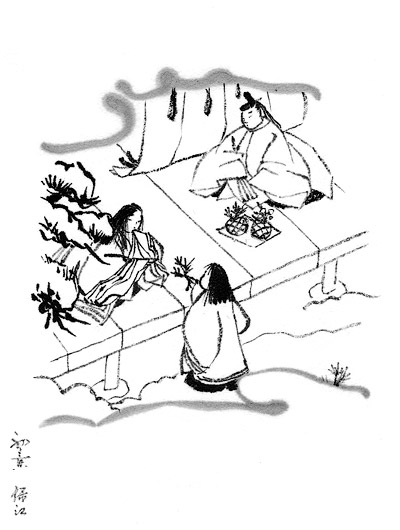
| A pictorial subject taken from "The First Warbler"
or more literally "The First Song", Chapter 23 of GENJI MONOGATARI 源氏物語
(The Tale of Genji). This very short chapter centers around an exchange of New
Year's greetings between Genji and the ladies of the Rokujou 六条 Mansion (see *Otome
乙女): Lady Murasaki (see *Wakamurasaki 若紫), the Akashi Lady (see *Akashi 明石,
*Matsukaze 松風), the Lady of the Orange Blossoms *Hanachirusato
花散里, *Tamakazura 玉鬘, the Safflower
Lady *Suetsumuhana 末摘花,
and the Lady of the Locust Shell *Utsusemi
空蝉. A frequently illustrated scene shows Genji receiving New Year delicacies
in bearded baskets, higeko 髭籠 (baskets with the ends of the woven strands
left untrimmed) and a warbler uguisu 鴬 on an artificial pine branch,
sent over by the princess's mother, the Akashi Lady . Attached to the branch is
a letter with a poem telling of her loneliness. Hatsune motifs on craft objects
were popular because of their auspicious, new-beginning symbolism. The elaborate
lacquered furnishings of Tokugawa Chiyohime's 徳川千代姫 trousseau, called Hatsune
no choudo 初音の調度 (1639; Tokugawa 徳川 Museum) are well-known for their decoration.
|
||||||
|
||||||
|
||||||
|
||||||
| REFERENCES: | ||||||
| *genji-e 源氏絵 | ||||||
|
||||||
|
||||||
|
||||||
| EXTERNAL LINKS: | ||||||
|
||||||
|
||||||
|
||||||
| NOTES: | ||||||
|
||||||
|
||||||
|
||||||
(C)2001 Japanese Architecture and Art Net Users System. No reproduction or republication without written permission. 掲載のテキスト・写真・イラストなど、全てのコンテンツの無断複製・転載を禁じます。 |
||||||