|
||
 |
||
 |
||
|


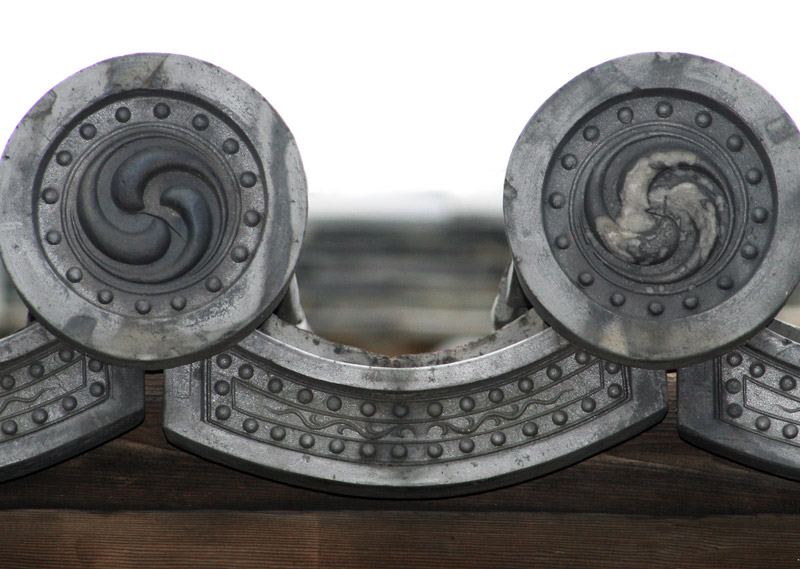
Gangouji
Gokurakubou Zenshitsu 元興寺極楽坊禅室 (Nara)
(C)2001 Japanese Architecture and Art Net Users System. No reproduction or republication without written permission.
掲載のテキスト・写真・イラストなど、全てのコンテンツの無断複製・転載を禁じます。
|
||||||
| shumon 珠文 | ||||||
|
||||||
|
||||||
|
||||||
|
||||||
| KEY WORD : architecture / roofing tiles | ||||||
|
||||||
| A raised bead, nipple or seed motif that became a common part of the decoration on the pendant tiles *gatou 瓦当 attached to semi-circular convex eave-end tiles *nokihiragawara 軒平瓦 and to broad concave eave-end tiles *nokimarugawara 軒丸瓦. Because of direct relations with the Tang dynasty during the latter half of the 7c, more elaborate patterns were introduced from China for both types of pendant tiles. The bead pattern became an integral form that encircled the lotus petal *renben 蓮弁 motif of the circular pendant tile and frequently filled the uppermost border on the broad concave pendant tile. The size of the beads and their spacing varied. The bead pattern continued to be used even after the lotus motif had been replaced by other motifs, such as the comma patterns *tomoemon 巴文, sword tip pattern *kentoumon 剣頭文 and patterns that featured the temple's name, mei nokimarugawara 銘軒丸瓦. When the beads are consecutively placed in a row, the terms shumontai 珠文帯, *renjumon 連珠文 are used. If the beads in a row are lozenge shaped, they are called renbishimon 連菱文, exemplified by a nokihiragawara excavated from the ruins of the site of Daikandaiji 大官大寺 in Nara. | ||||||
|
Gangouji
Gokurakubou Zenshitsu 元興寺極楽坊禅室 (Nara) |
||||||
|
||||||
|
||||||
| REFERENCES: | ||||||
|
||||||
|
||||||
|
||||||
| EXTERNAL LINKS: | ||||||
|
||||||
|
||||||
|
||||||
| NOTES: | ||||||
|
||||||
|
||||||
|
||||||
(C)2001 Japanese Architecture and Art Net Users System. No reproduction or republication without written permission. 掲載のテキスト・写真・イラストなど、全てのコンテンツの無断複製・転載を禁じます。 |
||||||