|
||
 |
||
 |
||
|


 |
 |
|
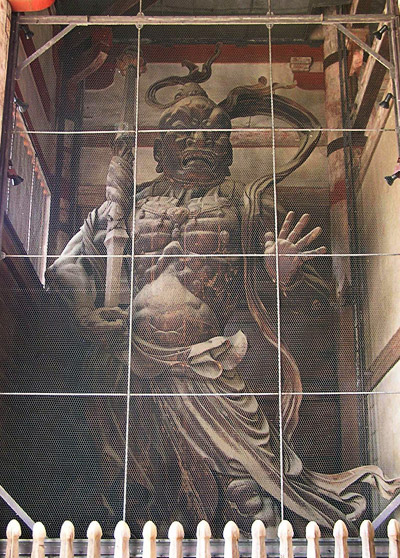
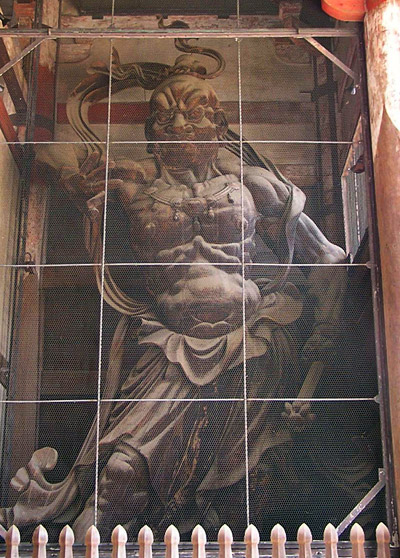
left:*agyou 阿形 right:ungyou 吽形 Toudaiji Nandaimon 東大寺南大門 (Nara) |
||
(C)2001 Japanese Architecture and Art Net Users System. No reproduction or republication without written permission.
掲載のテキスト・写真・イラストなど、全てのコンテンツの無断複製・転載を禁じます。
|
||||||
| Niou 仁王 | ||||||
|
||||||
|
||||||
|
||||||
|
||||||
| KEY WORD : art history / iconography | ||||||
|
||||||
| Also written 二王. Also called *niten 二天 and Niouson 仁王尊. Lit. two kings or benevolent kings. A pair of temple guardians who stand on either side of a temple gate. Their fierce faces with glaring eyes, powerfully muscular bodies, and threatening poses bearing weapons, serve to ward off evil spirits. Typically the Niou are represented as nude from the waist up, although very early images wear chest armor. Generally one opens his mouth, in the *agyou 阿形 position (the shape of mouth saying "a" あ ) and holds a thunderbolt (Sk: vajra, Jp: *kongousho 金剛杵), while the other closes his mouth, in the ungyou 吽形 position (the shape of mouth saying "un" うん) and holds a large sword . They are sometimes called *Kongou rikishi 金剛力士 and Misshaku rikishi 密迹力士, respectively, indicating two different aspects of one deity named Misshaku kongou 密迹金剛. However, there are various opinions as to the identities of the Niou, and none seems to clearly prevail. Iconographically, Niou are associated with *Shukongoushin 執金剛神. Chinese examples include large rock-cut sculptures at Longmen (Jp: Ryuumon 竜門) and Yungang (Jp: Unkou 雲岡). The earliest Japanese examples are the dry-lacquer *kanshitsu 乾漆 sculptures wearing armor and placed on the Buddhist altar, Shumidan 須弥壇 at Toudaiji *Hokkedou 東大寺法華堂 (popularly called the Sangatsudou 三月堂, also known as Kongou rikishi; 8c), and the nude example at Houryuuji 法隆寺 *Chuumon 法隆寺中門 (711). The best known Niou are the huge images at Toudaiji *Nandaimon 南大門 (1207) by Unkei 運慶 (?-1223) and Kaikei 快慶 (late 12c-early 13c). | ||||||
|
||||||
|
||||||
|
||||||
| REFERENCES: | ||||||
|
||||||
|
||||||
|
||||||
| EXTERNAL LINKS: | ||||||
|
||||||
|
||||||
|
||||||
| NOTES: | ||||||
|
||||||
|
||||||
|
||||||
(C)2001 Japanese Architecture and Art Net Users System. No reproduction or republication without written permission. 掲載のテキスト・写真・イラストなど、全てのコンテンツの無断複製・転載を禁じます。 |
||||||