|
||
 |
||
 |
||
|


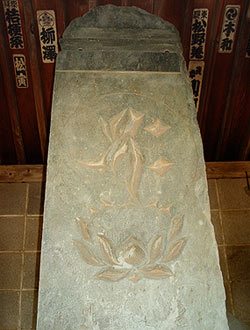
Shoufukuji
正福寺 (Tokyo)
(C)2001 Japanese Architecture and Art Net Users System. No reproduction or republication without written permission.
掲載のテキスト・写真・イラストなど、全てのコンテンツの無断複製・転載を禁じます。
|
||||||
| itabi 板碑 | ||||||
|
||||||
|
||||||
|
||||||
|
||||||
| KEY WORD : architecture / general terms | ||||||
|
||||||
| One type
of pagoda or stupa, touba 塔婆, in the form of a flat stone stele that
became prevalent in the early 13c and was widely used until the early 17c,
when it disappeared altogether. Two grooves are cut between the body of
the stupa and the pyramidal form at the top. The earliest examples were
40-60cm wide, tapering somewhat toward the top of the face just below the
grooved section. Later, they were much narrower, about 20cm or less. Some
itabi were believed to be as high as 5m, but it is more likely that
most were about 2m. Their origin is obscure and no clear reason for their
abrupt cessation is known. They were erected as memorials and as a visible
means to draw those who strayed from the "true path" of Buddhism back into
the fold. Sanskrit, or Buddhist images were carved into the upper part of
the body, while Buddhist texts, names and dates were cut in the lower part.
Some inscriptions seem to convey prayers. The names *Amida
阿弥陀 who ruled over the Western Paridise, *Shaka
釈迦 or *Dainichi
大日 of Esoteric Buddhism mikkyou 密教, appear many
times. A preponderance of itabi exists in the Kantou 関東 region, and
many are made of a green or greenish-blue stone from Chichibu 秩父 in Saitama
prefecture. Examples: Oonuma Kouen 大沼公園 (1227) ; Kannonji 観音寺 (1233), both
in Saitama prefecture; Shoufukuji 正福寺 (1248) in Tokyo. |
||||||
Shoufukuji
正福寺 (Tokyo)
|
||||||
|
||||||
|
||||||
| REFERENCES: | ||||||
| *gorintou 五輪塔 | ||||||
|
||||||
|
||||||
|
||||||
| EXTERNAL LINKS: | ||||||
|
||||||
|
||||||
|
||||||
| NOTES: | ||||||
|
||||||
|
||||||
|
||||||
(C)2001 Japanese Architecture and Art Net Users System. No reproduction or republication without written permission. 掲載のテキスト・写真・イラストなど、全てのコンテンツの無断複製・転載を禁じます。 |
||||||