|
||
 |
||
 |
||
|


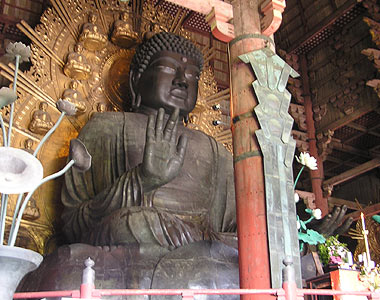
Toudaiji 東大寺 (Nara)
(C)2001 Japanese Architecture and Art Net Users System. No reproduction or republication without written permission.
掲載のテキスト・写真・イラストなど、全てのコンテンツの無断複製・転載を禁じます。
|
||||||
| daibutsu 大仏 | ||||||
|
||||||
|
||||||
|
||||||
|
||||||
| KEY WORD : art history / sculptures | ||||||
|
||||||
| Also jourokubutsu 丈六仏. The term used to describe a very large statue of Buddha. Originally any statue more than twice life-size was referred to as daibutsu. The size expressed the greatness and superhuman quality of the Buddha. The height of the statue was measured in traditional Japanese units of length; the shaku 尺 (30.3cm) and the jou 丈 (10shaku). A daibutsu was higher than 1 jou 6 shaku, or 4.85m, known in Japanese as *jouroku 丈六. This figure was used because it was said to be the actual height of Buddha. The oldest daibutsu in Japan is the Asuka Daibutsu 飛鳥大仏, erected in 606 in Nara's Asukadera 飛鳥寺, although on the present day statue only the face and the fingers of the right hand are original. Today the term daibutsu normally refers to the two most famous images in Japan which are the Great Buddha of Nara, a seated image of Vairocana Buddha (14.85m), erected in 752 in Toudaiji 東大寺, and the Great Buddha of Koutokuin 高徳院 (11.4m), Kamakura, erected in 1252, which has been left in the open air since the temple building was damaged in a storm. Traditionally, however, the three great Buddhas of Japan, or *sandaibutsu 三大仏 were the Great Buddha of Nara, in Taiheiji 太平寺, Osaka, and that in Sekidera 関寺, Shiga prefecture. Japan's daibutsu statues were generally made from cast bronze *chuukin 鋳金,and sometimes gold plated *kondoubutsu 金銅仏. | ||||||
Toudaiji 東大寺 (Nara)
|
||||||
|
||||||
|
||||||
| REFERENCES: | ||||||
| *Rushanabutsu 盧舎那仏 | ||||||
|
||||||
|
||||||
|
||||||
| EXTERNAL LINKS: | ||||||
|
||||||
|
||||||
|
||||||
| NOTES: | ||||||
|
||||||
|
||||||
|
||||||
(C)2001 Japanese Architecture and Art Net Users System. No reproduction or republication without written permission. 掲載のテキスト・写真・イラストなど、全てのコンテンツの無断複製・転載を禁じます。 |
||||||